
5 Self-Reflection Questions That Transform Your Leadership and Unlock Personal Growth

“Knowing yourself is the beginning of all wisdom.” — Aristotle
Most professionals are capable of so much more than they realize. The difference between those who reach their potential and those who don’t? It comes down to a practice that takes less than 15 minutes but delivers compound returns over time: intentional self-reflection.
I’ve spent over two decades leading sales teams, turning around struggling sales teams, and coaching professionals to breakthrough performance. What I’ve learned is that the highest performers aren’t necessarily the most talented—they’re the most self-aware. They ask themselves tough questions and use the answers to guide their decisions, sharpen their focus, and accelerate their growth.
Self-reflection isn’t complicated, but it is specific. The questions you ask yourself matter. Ask the wrong questions, and you’ll spin your wheels. Ask the right ones, and you’ll unlock insights that change everything.
The following are five powerful self-reflection questions that have helped me and countless professionals I’ve coached. These aren’t surface-level questions. They’re designed to push you beyond comfortable answers and force you to confront what’s really driving—or limiting—your success.
Why Self-Reflection Is Your Competitive Advantage
Before we dive into the questions, let’s address something important: self-reflection isn’t navel-gazing. It’s strategic.
Research consistently shows that leaders who practice regular self-reflection make better decisions, build stronger teams, and adapt more effectively to change. They understand their emotional triggers before those triggers hijack important conversations. They recognize patterns in their behavior that others miss. They know when to double down on their strengths and when to ask for help.
Think about the last major decision you made at work. Did you rush into it, or did you pause to consider your motivations, your blind spots, and alternative approaches? The professionals who consistently outperform their peers are the ones who build that pause into their routine.
Self-reflection is only as powerful as you allow it to be. You can use it to improve yourself, or you can treat it like a checkbox on your personal development list. The difference comes down to asking questions that actually challenge you.
The Five Questions That Change Everything
1. What Are My Core Beliefs and Values?
You can’t make smart decisions that work for you if you don’t have a strong grip on your core values and beliefs.
Here’s what most people miss: knowing your values isn’t the same as living them. I’ve met dozens of sales leaders who say they value “work-life balance” but check email at midnight and skip family dinners. I’ve coached managers who claim “transparency” is critical but hold back feedback because it feels uncomfortable.
The gap between stated values and lived values is where performance breaks down.
So, reflecting on your principles and trying to understand what matters to you and what you stand for is essential work. What is it that drives your decisions? Do your daily actions align with the values you’ve identified? When you face a tough choice at work, which principles guide you—and which ones do you conveniently ignore?
Take fifteen minutes this week and write down your top five values. Then audit your calendar for the last month. Does how you spend your time reflect what you say matters most? If not, you’ve just identified your first area for growth.
2. What Are My Weaknesses and Strengths?
One of the core components of personal growth is self-awareness, so you need to do the work to understand yourself better. Understanding your weaknesses and strengths is a big part of that.
But here’s the truth that most self-help content won’t tell you: identifying your strengths and weaknesses isn’t a one-time exercise. As you grow, as your role changes, as your industry evolves, your strengths shift. What made you successful five years ago might be holding you back today.
Consider your areas for improvement and where you could grow. What special skills or qualities do you possess, and what are you exceptionally good at? More importantly, what situations bring out your best work—and which ones consistently drain your energy or expose your limitations?
If you want to leverage your strengths for success, you need to understand what they are. Uncovering your weaknesses is also a helpful step because one, you can improve on them where necessary, and two, you can accept help from others for those areas.
I’ve seen professionals waste years trying to fix weaknesses that would be better addressed through delegation or partnership. The question isn’t just “What am I bad at?” It’s “Which weaknesses actually matter for my goals, and which ones can I work around?”
3. What Are My Aspirations and Goals?
If you want to assess your aspirations and goals, you need self-reflection. What are your short-term plans? What about your long-term vision? Are you moving in the right direction? Have you drifted off the course you set? Do your commitments and activities align with your short and long-term goals?
Most people I coach are busy. They’re executing tasks, attending meetings, responding to urgent requests. But when I ask them, “What are you building toward?” they pause. They’re not sure.
That’s a problem.
Clarifying your aspirations and goals helps you set a clear direction. It empowers you to prioritize your actions and focus your energy on making your desired outcomes come true.
You can regularly revisit your goals as part of a self-reflection routine because everyone changes over time. Sometimes your values change, sometimes your priorities shift, and if you want it all to work together, you need to know where those shifts are happening.
Here’s a framework that works: every quarter, block two hours on your calendar. Review your goals. Ask yourself whether they still align with who you’re becoming and what you actually want. If they don’t, adjust. There’s no award for sticking with a goal that no longer serves you.
4. What Have I Learned From My Failures and Mistakes?
A lot of people make a mistake and think they’ve failed. Or they experience failure and think it’s the end of the world. Neither of those things is true—it’s just a temporary setback.
I’ve attended professional golf tournaments where I watched PGA pros hit bad shots. What impressed me wasn’t their perfect drives—it was their recovery shots. They didn’t dwell on the mistake. They assessed the situation, planned their next move, and executed. Often, that recovery shot put them right back in contention.
You can convince yourself that setbacks are temporary by answering the question of how much and what you learned from those failures and mistakes in your past. Those mistakes and failures shape the decisions you make and build your character.
Learning to embrace your failures and extract lessons is a crucial part of personal growth. But here’s the key: you have to actually extract the lesson. Saying “I learned from that” isn’t enough. You need to identify the specific behavior, decision, or assumption that led to the outcome—and commit to doing something different next time.
When I’ve coached sales teams through difficult quarters, I didn’t focus on who missed their numbers. I focused on what we learned about our process, our messaging, or our target market. That shift from blame to learning changes everything.
5. Am I Fulfilling My Purpose and Living Authentically?
Living authentically is important, but are you? Are you doing what it takes to fulfill your purpose? Use self-reflection to see whether your life aligns with your purpose.
Are you living based on the path you have been crafting, or according to external pressure or societal expectations?
This is the hardest question on this list because it forces you to confront something uncomfortable: the gap between who you are and who you’re pretending to be. Maybe you’re in a role that pays well but drains you. Maybe you’re pursuing goals that look impressive but don’t actually fulfill you.
Purpose and authenticity can drive your fulfillment and success, but you need to tap into that motivation and passion. When you’re operating from your authentic self—when your work aligns with your purpose—you don’t need external motivation. The work itself energizes you.
I’m not suggesting you quit your job tomorrow to “find yourself.” I’m suggesting you get honest about whether the path you’re on is taking you somewhere you actually want to go. Small adjustments in how you work, what you prioritize, and where you invest your energy can close that gap over time.
Making Self-Reflection a Practice, Not a Task
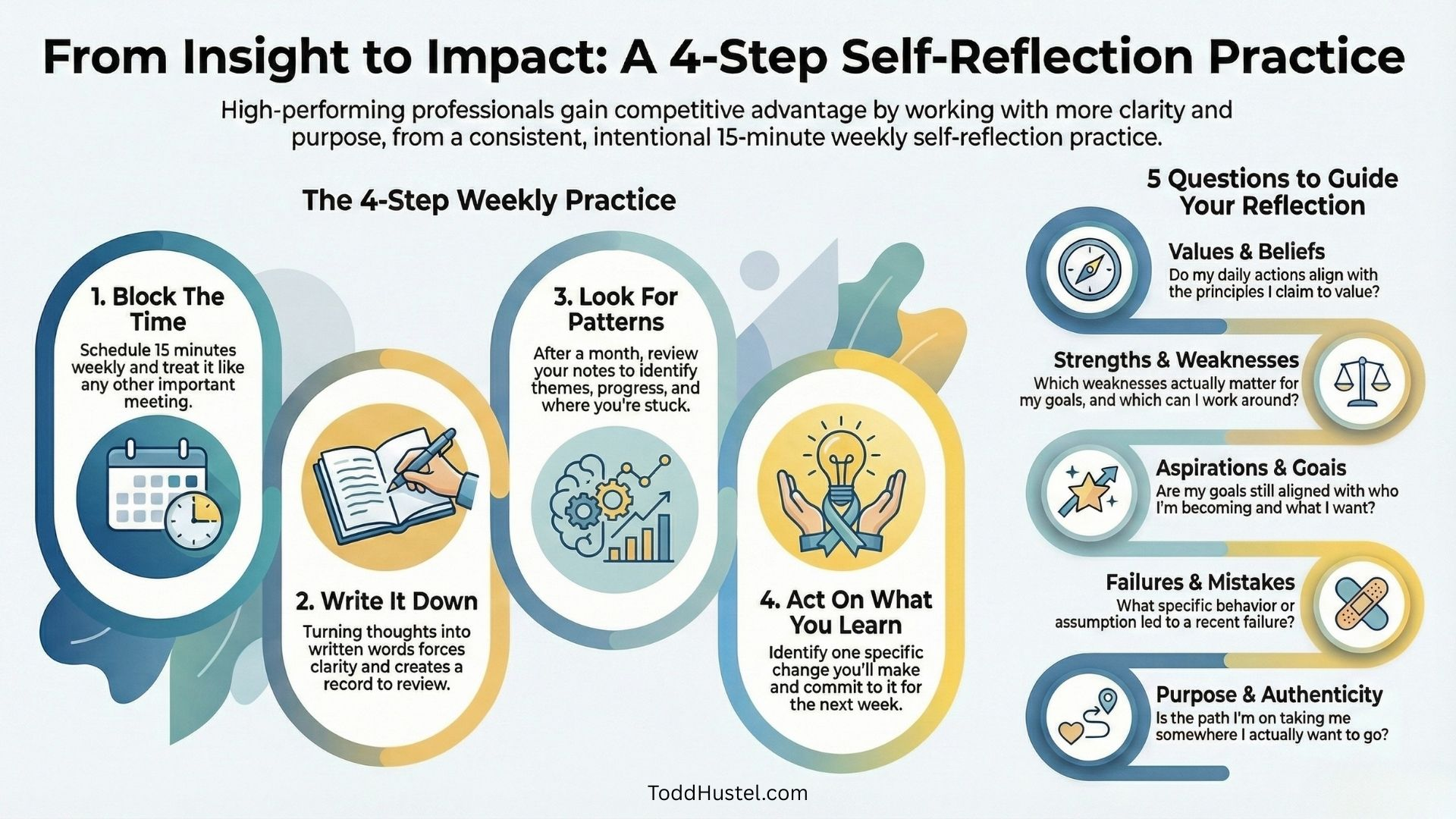
Use these self-reflection questions as part of a regular reflection routine to motivate yourself and foster personal growth. Self-reflection isn’t a one-time task—it’s something you’ll need to rely on frequently. It’s all part of the self-discovery journey.
Here’s one way to build this into your routine:
Block the time.
Put 15 minutes on your calendar every Friday afternoon. Treat it like any other important meeting. You wouldn’t skip a one-on-one with your boss; don’t skip your one-on-one with yourself.
Write it down.
Thinking about these questions isn’t enough. Write your answers. The act of writing forces clarity and creates a record you can review over time.
Look for patterns.
After a month of weekly reflection, review your notes. What themes emerge? Where are you making progress? Where are you stuck? The patterns reveal what’s really happening beneath the surface.
Act on what you learn.
Self-reflection without action is just interesting thinking. Identify one specific change you’ll make based on your insights, and commit to it.
The professionals who consistently exceed expectations aren’t working harder—they’re working with more clarity and purpose. That clarity comes from asking better questions and being honest about the answers.
What will you do this week to start your self-reflection practice? The questions are here. The only thing missing is your commitment to answer them.
Make it a great day.